Jenni 'JWoww' Farley Blasts United Airlines Over 'Insane' Fares and 'Corporate Greed'
Jenni 'JWoww' Farley, the well-known figure from Jersey Shore, recently launched a fervent social media critique against the soaring prices of air travel, singling out United Airlines for its 'insane' fare structures and what she labeled as 'corporate greed.' Farley detailed her frustrating experience when attempting to book flights from Newark, New Jersey, to Miami. She found first-class roundtrip tickets priced close to $4,000 and one-way economy fares at $800. Beyond the base cost, she expressed particular dismay over an additional $55 per person fee just to select seats, arguing that such a charge for a basic amenity compounded an already luxurious expense. Her rant resonated with many followers who echoed her sentiments about airlines increasingly catering only to the wealthy. In extensive posts, Farley highlighted that economy tickets for a mere three-hour flight exceeded $1,200 per person round-trip. She challenged the notion of seat selection as a luxury and directly appealed to United Airlines to recognize the economic hardships faced by ordinary families. She asserted that companies should strive for improvement and offer more value, rather than extracting every possible dollar from consumers during challenging financial times. Farley criticized the 'audacity' of charging premium prices for what she considered minimal service, calling United's first-class offerings 'ghetto' despite her 14 years of loyalty.


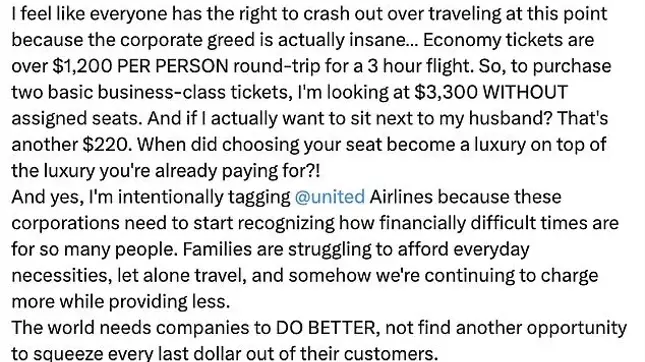


In a striking display of public dissatisfaction, Jenni 'JWoww' Farley, the familiar television personality from MTV's 'Jersey Shore,' recently unleashed a passionate tirade across her social media platforms, lambasting the exorbitant costs associated with modern air travel. Her sharp criticism was primarily directed at United Airlines, whom she accused of blatant 'corporate greed.' The incident unfolded on a Friday, when Farley, aged 41, sought to arrange air transportation for herself and her husband from Newark, New Jersey, to the vibrant city of Miami, Florida. Upon reviewing flight options, Farley was aghast to discover first-class roundtrip tickets nearing an astonishing $4,000. Even the more modest economy class tickets were priced at a hefty $800 for a one-way journey. The core of her grievance intensified with the revelation of additional fees: a mandatory $55 per person simply to select seats adjacent to one another. 'When did choosing your seat become a luxury on top of the luxury you're already paying for?!' she questioned rhetorically to her substantial audience on TikTok and X. Farley’s critique highlighted that a basic business-class fare for two, excluding pre-assigned seating, approached $3,300, with an extra $220 required to guarantee side-by-side seating. She passionately argued that airlines, particularly United, need to acknowledge the widespread financial strain affecting households. She stressed that while families grapple with affording daily necessities, the airline industry seems to be moving in the opposite direction, increasing charges while simultaneously diminishing the overall customer experience. Having maintained 14 years of loyalty to United Airlines, Farley expressed profound disappointment, even going so far as to describe their first-class amenities as 'ghetto,' asserting that long-standing customers deserved better than 'luxury prices while delivering the bare minimum.'
This incident serves as a poignant reminder of the growing disconnect between corporate travel entities and the average consumer. While Jenni Farley's celebrity status amplifies her voice, her frustration resonates with countless travelers facing similar dilemmas. The practice of unbundling services, where basic amenities like seat selection incur additional costs, has become a significant point of contention. It highlights a broader issue in the service industry: the push for maximized revenue often comes at the expense of customer goodwill and basic expectations. Airlines, as essential service providers, bear a responsibility to offer transparent, fair pricing and maintain a reasonable standard of service, particularly when economic times are challenging for so many. This public outcry from a prominent figure might just be the catalyst needed to spark a wider conversation and potentially prompt a reevaluation of these increasingly unpopular pricing strategies.